- Mirrors
- Angle
- Symmetry
- One bead, many images
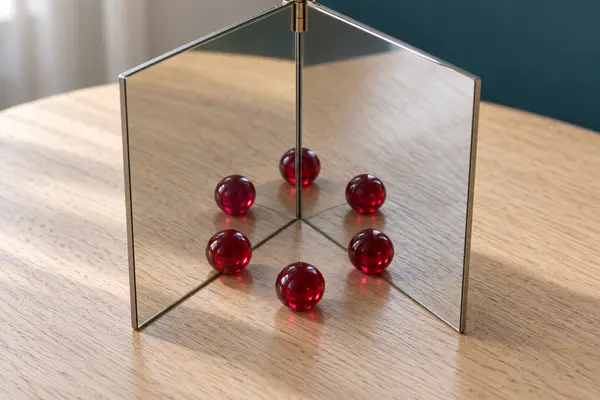
THE MIRRORS
Reflections of reflections
Each mirror reflects the object and the other mirror. The closer the mirrors, the more copies you see.
Change the angle doodlekaleidoscope
Updated
THE SCIENCE OF A TOY
A kaleidoscope is a lesson in reflection you can hold in one hand.
Turn the tube and a few loose pieces of glass become a perfectly balanced star. The trick is not the glass but the mirrors, and above all the angle between them. Here is how it works, and how an 1816 invention became a craze.
Plain English, with the sources linked.
60° six images
Try the mirror angles
HOW IT WORKS
Three parts do all the work:
the mirrors, their angle and the object cell.
THE MIRRORS
Each mirror reflects the object and the other mirror. The closer the mirrors, the more copies you see.
Change the angleTHE ANGLE
Mirrors at 60° give six images. Angles that divide a full circle evenly give the neatest patterns.
Why 60°?THE OBJECT CELL
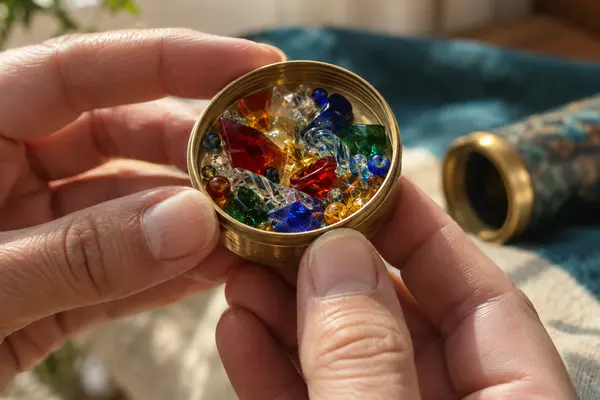
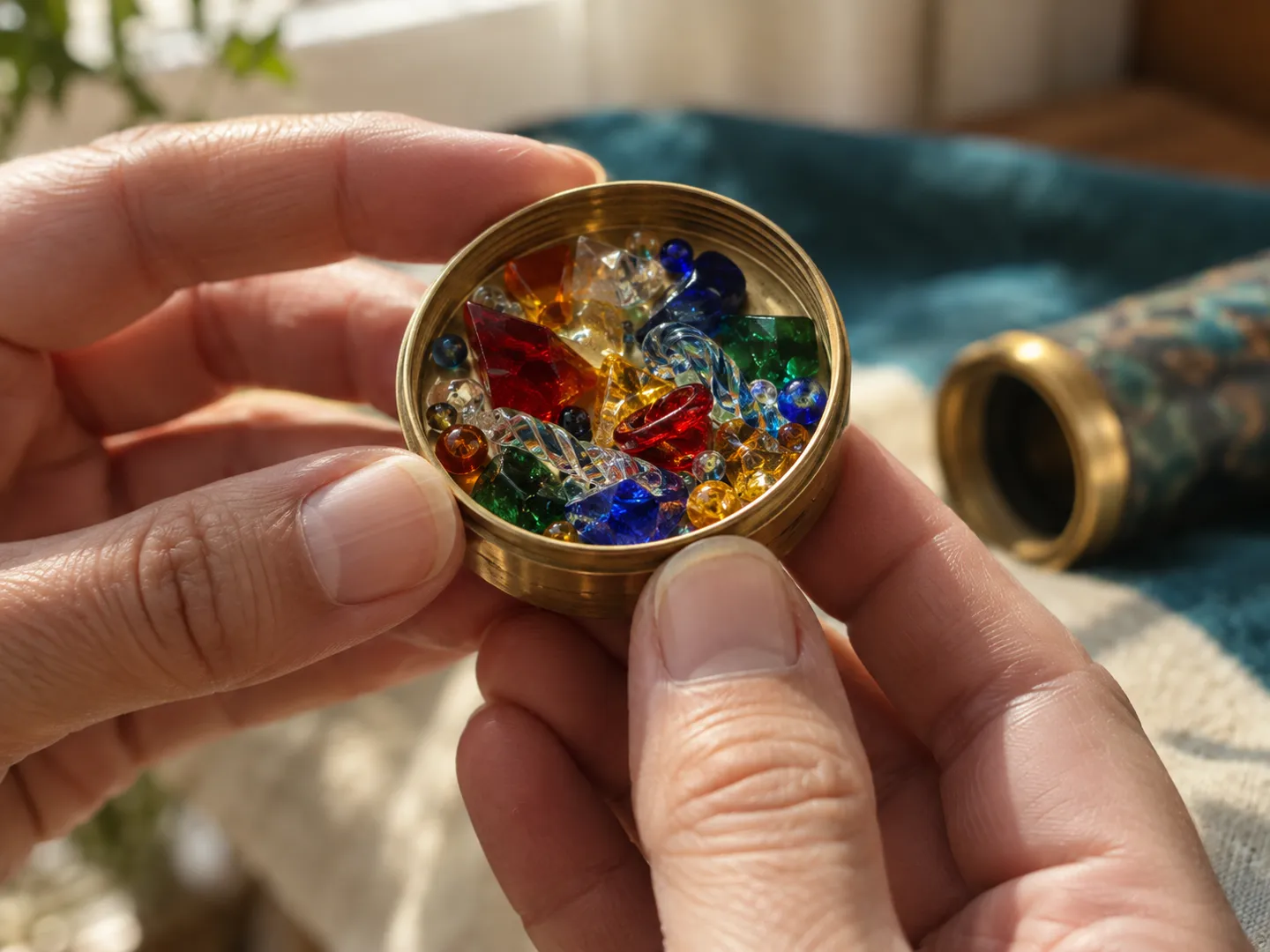
Coloured pieces tumble at the far end. Every turn rearranges them, and the mirrors make it symmetrical.
Make one at homeTRY THE MIRROR ANGLES
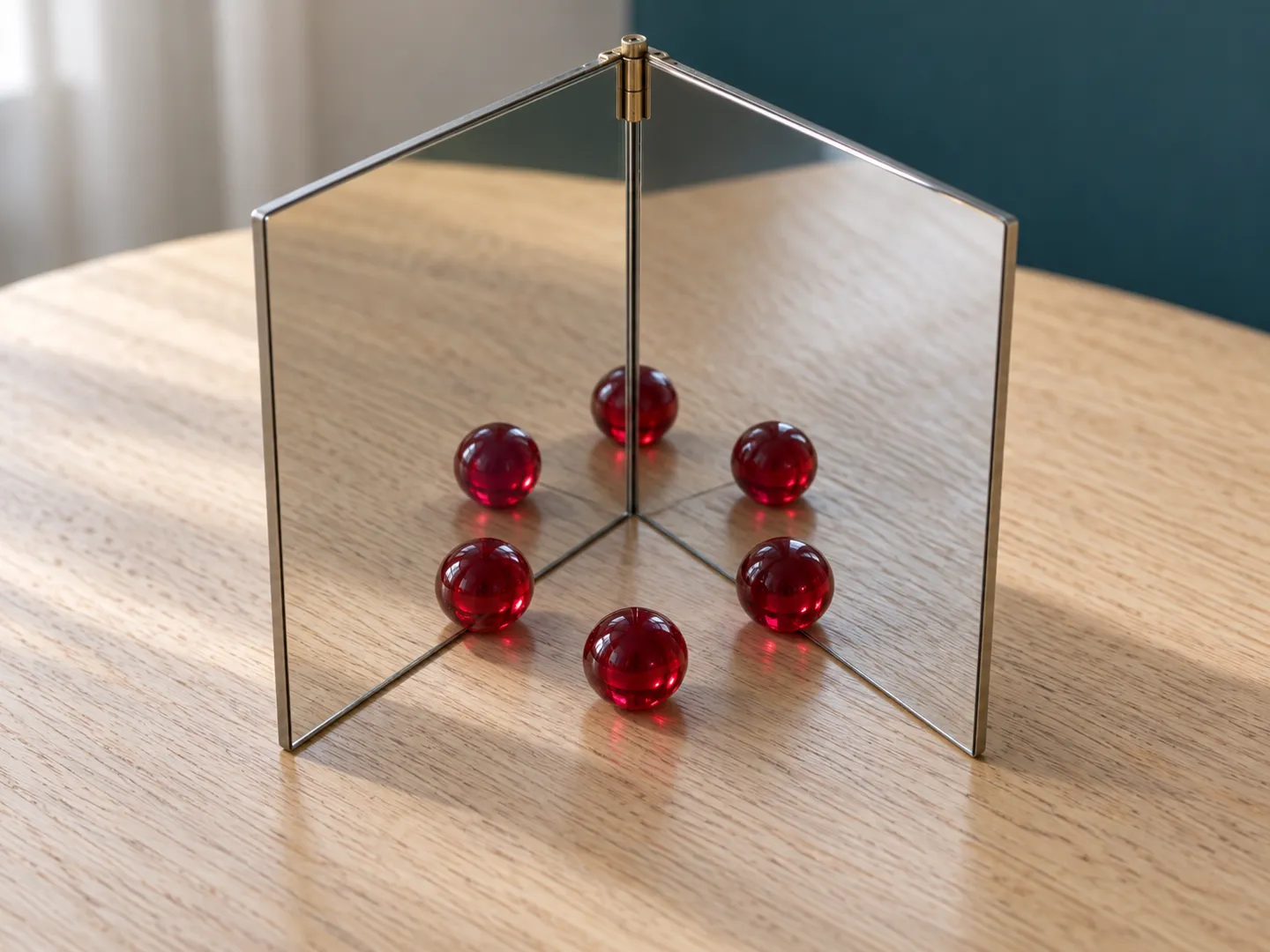
Imagine two mirrors hinged like a book, with one bead between them. Pick the angle between the mirrors to see how many beads you would count, including the real one.
These are the counts from a classroom investigation by Science World. Smaller angles give more images, but each extra reflection is dimmer.
A REGENCY CRAZE
The instrument spread faster
than its inventor could protect it.
200,000 in 3 months
Sold in London and Paris
Brewster's kaleidoscope caught on almost at once. Accounts of the time record about 200,000 sold in London and Paris within three months, many of them cheap copies.
THE CRAZE · LONDON AND PARIS
1816 to 1817
Copied before it was protected
Brewster created the kaleidoscope in 1816 and patented it in 1817, but the design was copied and mass-produced before the patent was granted, so he earned little from the boom.
THE PATENT · 1817
By 1822 a British traveller in America found kaleidoscopes made in great quantities and given to children as playthings, and decorative designers took up its symmetrical, non-symbolic patterns.
TRY IT AT HOME
Tape two small flat mirrors together along one edge so they open and close like a book.
On paper, mark lines at 120°, 90°, 60°, 45° and 30°. Stand the mirror book on each in turn.
Put one bead between the mirrors and count the images at each angle. Compare with the explorer above.
Try an angle that does not divide 360° evenly. Notice where the pattern no longer lines up.
KALEIDOSCOPE FACTS
The name is built from Greek: kalos (beautiful), eidos (form) and skopein (to view).
With mirrors inclined at 60°, one object produces six regularly placed images in a hexagonally symmetrical pattern. At a right angle you get four.
When the angle between the mirrors is an even division of 360°, the reflections join up into a clean, repeating pattern.
The reflections seem endless, but you can only see a finite number, because each mirror absorbs and scatters some of the light.
Brewster was born on 11 December 1781. In Japan his birthday is marked as kaleidoscope day.
QUICK QUESTIONS
Short answers to the questions people ask most.
Who invented the kaleidoscope?
The Scottish physicist Sir David Brewster invented it around 1816 and patented it in 1817. He went on to publish a book about it in 1818, with an expanded second edition in 1858.
What does the word kaleidoscope mean?
It was built from three Greek words: kalos, meaning beautiful, eidos, meaning form, and skopein, meaning to view. Roughly, an instrument for viewing beautiful forms.
Why do kaleidoscope mirrors meet at 60 degrees?
At 60 degrees one object is reflected into six regularly placed images, giving a balanced hexagonal pattern. Angles that divide 360 degrees evenly give the neatest patterns; others leave a visible seam.
Do the reflections go on forever?
They look endless, but the number you can see is finite. Each mirror absorbs and scatters a little of the light, so every further reflection is dimmer than the one before.
How many mirrors does a kaleidoscope have?
Simple versions use two mirrors set at an angle. The standard design has three mirrors forming an equilateral triangle, which repeats the pattern across the whole view rather than around one point.
A NAME FULL OF COLOUR
doodlekaleidoscope.com is part of the DoodleSale portfolio. It isn't in an auction right now, but you can ask about leasing it.